Originally published at https://medium.com/p/60dc0a6ca50e
We are living in a world where we believe that we have the right to keep our private information secret, do not trust third parties, yet we achieve this by trusting some institutions and/or people. This is a philosophical discussion rather than a conspiracy theory.
The need for distrust
Why should we trust or distrust others? That is a very hard question to answer. But, let’s approach the question using a well-understood concept in physics. In mechanics, there is a notion called equilibrium and it has two forms: stable and unstable equilibrium. Perhaps, a visual explanation would be easier to understand. Look at the two figures below. A stable equilibrium is a stronger form of equilibrium where it is hard to disrupt the system. Even, when the system is disturbed, natural laws of physics evolve the system to return its balanced position. In contrast, when the unstable equilibrium system is messed with a tiny force, the system gets destroyed. A ball on top of a hill, though is at rest and thus balanced, will move downwards upon a tiny push. However, if the ball is sitting at the bottom of the well, it will return to its original position after several oscillations once it is forced to move (of course, if we do not neglect friction).
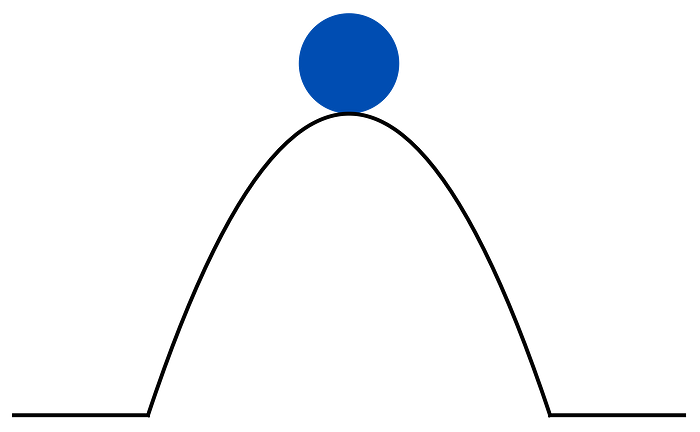

Trust has a similar property. In a closed society, if everyone trusts each other that everyone will behave honestly, this creates unstable equilibrium. Society breaks down when at least one person starts cheating or acting maliciously. Unfortunately, the world has seen such catastrophic examples. In many religions, believers are demanded to trust the exceptional capabilities of creators and it is forbidden to question them. As a result, leaders of the community can misuse the honest feelings of ordinary people to get themselves richer and/or powerful.
But, how to live with no trust at all? That is almost impossible. As human beings, we have feelings and we want to trust people we love and live a happier life. When those people betray us, we feel devastated. But if we did not trust at the beginning, maybe, we would have an unhappy and stressful life. The solution one can think of is to trust something that we do not have control over and choose our loved ones who trust that something as well. Again, religions are a good example of that. But not the only ones.
Is there deep ultimate truth (except what every religion offers) that we can build everything upon that? Like, the axiom of choice in set theory, 0 is a natural number, or the speed of light c is a constant, independent of the relative motion of the source. Certainly, they are useful and had a great impact on our life, scientific and technological advances. These are fundamental axioms of math and special relativity that are “obviously true”. In math, everything boils down to logic. Logic is a formal way of reasoning to evade subjective beliefs.
Cryptography as a solution
Let’s choose (formal) logic as the basic unquestionably true system to construct the rest of the world. We start by developing mathematics as a tool, because it helps to solve problems, such as (ac)counting. Upon observations and experiments, it is possible to devise intuitive and/or counter-intuitive theoretical scientific models and prove their correctness (under certain assumptions) using math. Moreover, we end up with a modern technologically advanced society.
Now, it is time to use this technology as a tool to help people form communities, social bonds, and ultimately civilization. This has to start from an interaction between people. Communication is a basic way of interaction. And, often, we want our conversations to be private. Not necessarily for malicious reasons, but due to distrust. It may be used by others against us if we let everyone know our secrets. For example, our medical information, financial status, love affairs, political views, etc. If communicating parties are in close contact, they can create an invisible social chamber, assuming others will not eavesdrop on their conversation. In other words, they create a secret channel or medium between themselves. For example, today, we exchange information over digital channels. The secrecy of the contents is preserved in several layers using digital and physical security solutions. Of course, they are not perfect, but, engineers are trying their best to minimize errors.
Cryptography is a branch of computer science that studies techniques of secure communication — the thing we need in a distrustful environment. Advanced math is used in cryptographic protocols which are not easily explainable for ordinary people. So they have to trust the math behind it. But, trusting math is rather achievable: learning necessary preliminaries, everyone can repeat proofs and convince themselves if the statement is true or not.
However, this doesn’t solve the trust problem. What if designers of new tools are malicious people? What if backdoors are injected into implementations? This is harder to detect. Here, the only possible solution is transparency. The design and choice of parameters rationale can or should be open access to everyone. For example, why in NIST curve coefficients are generated by hashing unexplained seeds? Because NIST is a governmental entity, it affects legal frameworks and can force private and public organizations (at least in the USA) to follow their so-called standards. If they secretly injected exploitable weakness into the cryptosystem, then the government (at least, intelligence departments) may learn our secrets without prior consent. Thus, our right to privacy is violated.
Final thoughts
Maybe, instead of complicating the life to make it happy place, we should accept it as the way it is. Because, learning math is not a solution for happiness, though it may bring some. And, one cannot expect everyone to be proficient in math to build unbreakable society.
UPDATE: When I originally wrote this article, I was a staunch advocate of the formalism (mathematics), aligning myself with the views of David Hilbert. Consequently, I expressed my opinion that “In math, everything boils down to logic.” However, my perspective on this matter has since evolved, and I no longer hold this view as firmly as I once did.